


Instant auto crash leads can be the difference between winning and losing a personal injury claimant.
When a prospect calls after a motor vehicle accident, they’re evaluating multiple firms simultaneously, and the attorney who responds first typically secures the case.
At On Point Legal Leads, we’ve seen firsthand how instant auto crash leads transform case acceptance rates. We know from first-hand experience the importance of speed to lead.
Simply put, law firms that connect with prospects in 60 seconds or less, rather than hours, close significantly more cases and build stronger client relationships from day one.
Instant Auto Crash Leads: Why the First Call Wins the Case
The 78 Percent Rule That Determines Case Outcomes
The statistics are unforgiving. According to the Legal Trends Report from 2024, 78 percent of accident victims hire the first lawyer they speak with.
We’ve witnessed this type of success with our in-house legal intake center that calls qualified auto accident leads.
This isn’t a suggestion or a preference. Rather, it’s the reality of how injured people make decisions when they’re vulnerable and seeking help. The moment a prospect picks up the phone or submits a form after a crash, they’ve already decided they need an attorney. Your job is to be that attorney, and you have minutes to make it happen.
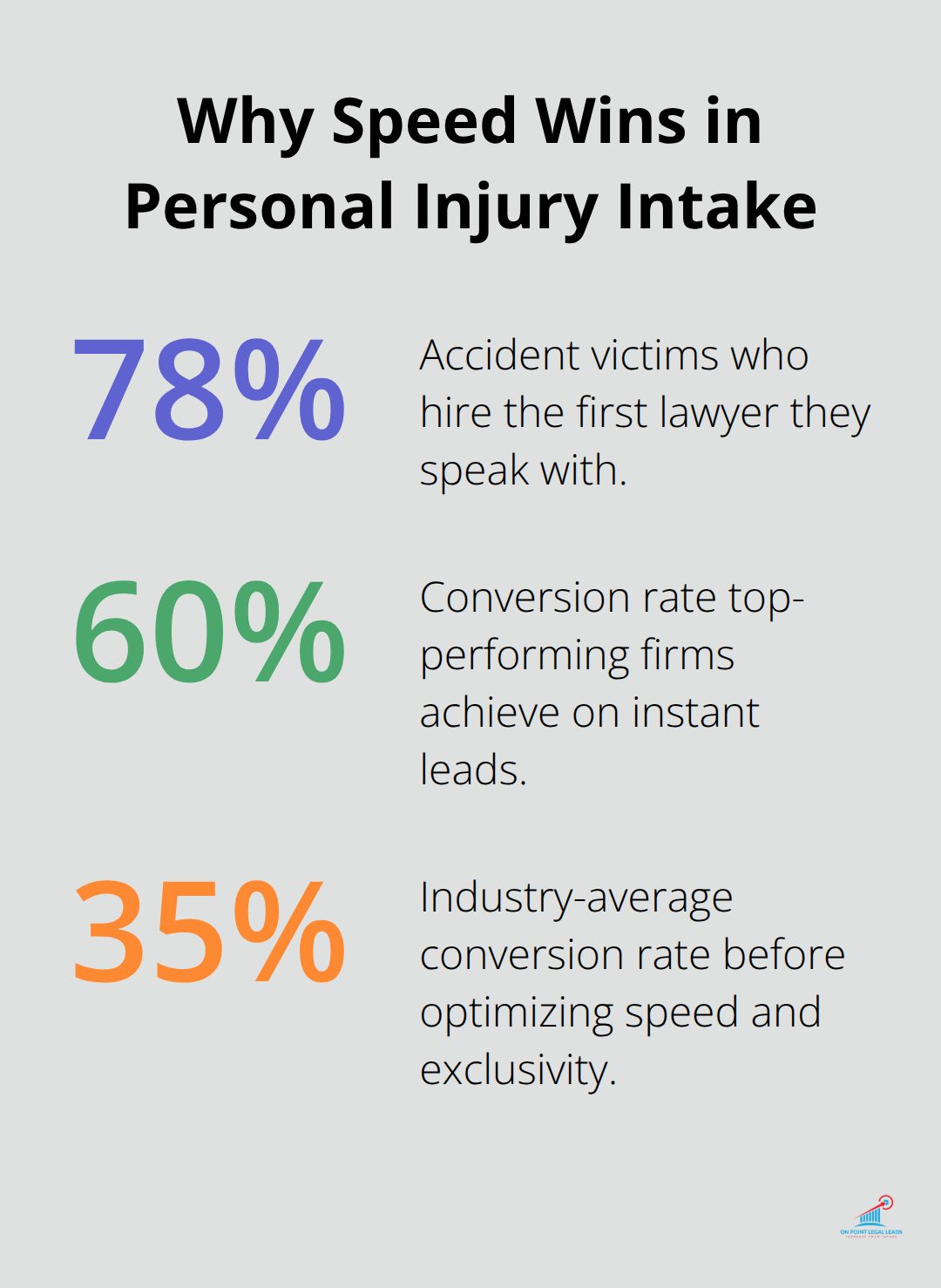
Firms that respond within 5 minutes of lead receipt convert significantly more cases than those who wait hours. That said, our legal intake staff strives to engage with instant auto crash leads in less than 60 seconds.
The difference between a 40 percent conversion rate and a 60 percent conversion rate often comes down to whether your team answered the phone while the prospect was still in decision mode or called back after they’d already hired someone else.
Why Speed Beats Everything Else in High-Value Markets
The competitive pressure in motor vehicle accident cases is intense, especially in high-value markets.
California, Florida, and New York see some of the most aggressive lead competition because settlements routinely reach five or six figures. When a prospect receives a lead from multiple sources simultaneously-whether through directories, paid ads, or referrals-the first firm to establish real contact wins.
Delayed responses push prospects toward competitors, and once they’ve signed with another attorney, that case is gone. Many firms underestimate how quickly this happens. A two-hour response window sounds reasonable until you realize your competitor responded in 15 minutes.
We also understand that prospective claimants who submit their information on social media platforms will subsequently be served multiple ads from competitors. That means that claimant may submit their information to other firms. Hence, even if a lead is not shared with other law firms, once you receive a lead you can bet that other intake teams likely will receive details about that same claimant’s accident.
We’ve worked with law firms across the country and our experience is that firms with experienced intake teams understand that speed-to-lead is how you win with instant auto crash leads. Adding an AI calling platform to improve contact rates can make a difference, as it has with our intake team.
Exclusive Leads Eliminate the Competition Problem
Exclusive real-time leads eliminate this problem entirely because you’re the only firm contacting the prospect. When you receive an instant lead, you’re competing against time, not other attorneys. That’s a fundamentally different and far more winnable position. Your intake team can focus on qualification and relationship-building rather than racing against other firms for the same prospect’s attention. This advantage compounds across your entire pipeline-more prospects convert, your case acceptance rate climbs, and your practice grows on a foundation of speed and exclusivity.
What Instant Auto Crash Leads Actually Mean for Your Bottom Line
Real-time and instant auto crash leads can transform the economics of your practice fundamentally.
When a prospect reaches out after a motor vehicle accident, they enter active decision mode, and firms that connect within minutes capture cases that would otherwise go to competitors. The difference between a 40 percent case acceptance rate and a 65 percent rate often reflects nothing more than response speed and lead exclusivity. Firms receiving instant, exclusive leads see measurable improvements in case volume and settlement value because they work with prospects who have not yet signed with another attorney. This is not about luck or market conditions; it is about controlling the variable that matters most.
Exclusive real-time leads cost more upfront-typically $250 to $600 per lead depending on region and case quality-but the math favors quality over volume. A single case in a high-settlement state like California or Florida easily exceeds $50,000 in value, meaning one converted exclusive lead pays for dozens of lower-quality prospects.
Firms that invest in instant delivery report conversion rates climbing from the industry average of around 35 percent to 50 percent or higher because they eliminate the friction of late responses and competing intake teams.
How Exclusivity Transforms Your Intake Process
Exclusive leads fundamentally change how your intake team operates. Instead of racing against other firms for a prospect’s attention, your team focuses entirely on qualification and relationship-building. This shift matters more than most firms realize. When multiple attorneys contact the same prospect simultaneously, intake becomes transactional and rushed.
The prospect feels pressured, asks minimal questions, and often chooses based on who called back fastest rather than who offered the best representation. With exclusive leads, your intake team has breathing room to verify injury severity, assess liability indicators, confirm insurance coverage, and understand retention potential without competing for attention. This deeper qualification actually improves case quality because you avoid accepting marginal prospects just to hit volume targets.
Many firms also discover that exclusive leads allow them to implement stronger intake scripts. Instead of speed-focused scripts designed to close before competitors call, you can use qualification-focused scripts that ask the right questions, gather critical details, and identify cases worth accepting. The result is fewer low-value cases in your pipeline and more high-potential cases moving to your attorneys.
Maximizing Conversions Through Immediate Response Protocols
Converting instant auto crash leads requires more than receiving them quickly; it requires systems designed specifically for real-time delivery.
Firms that convert 60 percent or higher of instant leads share one characteristic: they build intake protocols around immediate response. This means having dedicated staff available during peak hours, typically 9 a.m. to 5 p.m. on weekdays when most accidents occur and prospects seek representation. Phone response should happen within five minutes of lead delivery. Email and SMS follow-up should happen within 15 minutes if phone contact fails. This is not theoretical; the first attorney to speak with a prospect wins the case 75 percent of the time, and delays beyond five minutes cause measurable conversion drops.
Law firms also track which intake team members convert at highest rates and ensure those people handle real-time leads during peak windows. Lead scoring systems help prioritize high-value prospects-cases involving clear injury, multiple vehicles, or high-severity incidents receive immediate attention from senior intake staff, while lower-severity cases receive standard follow-up.
Documentation matters significantly; firms that capture accident details, injury descriptions, insurance information, and representation status during first contact convert more cases because they have the information needed to make quick case decisions and move qualified prospects to attorney consultation.
Why Your Intake Team Determines Lead Value with Instant Auto Crash Leads
The quality of your intake team directly determines whether instant leads convert or slip away. A prospect who reaches out after a crash is vulnerable, confused, and evaluating multiple options simultaneously. Your intake staff either builds trust and moves the prospect toward retention or creates friction that pushes them toward competitors.
The best intake teams combine speed with empathy-they answer quickly, ask the right questions, and make the prospect feel heard rather than rushed. This approach works because prospects remember how they were treated during intake more than they remember marketing messages or firm credentials.
Firms that prioritize intake quality over intake volume consistently outperform those that treat intake as a volume game. Your next step involves building the systems and team structure that allow you to handle instant leads at scale without sacrificing the personal touch that converts prospects into clients.
How to Qualify Instant Auto Crash Leads Before Your Intake Team Wastes Time
Not every car crash lead that arrives in real-time deserves your intake team’s attention.
Firms converting 60 percent or higher of instant auto crash leads do not accept everything; they ruthlessly filter prospects before handoff to attorneys. This filtering happens during lead delivery, not after your staff has already invested 20 minutes on qualification calls. When you work with a provider like On Point Legal Leads, each lead has already passed multi-point screening for accident details, injury severity, insurance coverage, and representation status. Your firm still needs an internal qualification framework that matches leads to your specific case acceptance criteria.
Establish Your Case Acceptance Boundaries
Some practices only accept cases above a certain injury threshold. Others focus exclusively on clear liability situations. A few specialize in specific vehicle types like truck accidents or motorcycle crashes. Your qualification process should reflect these boundaries immediately, not after your intake team has already engaged the prospect. Define what cases your firm will accept before leads arrive, then train your intake staff to filter against those criteria during first contact. This prevents wasted time on prospects who do not fit your practice focus.
Verify Injury Severity in the First 90 Seconds
A prospect reporting soft tissue pain differs fundamentally from someone describing hospitalization, surgery, or ongoing treatment. Your intake script should capture specific injury details within the first 90 seconds: Were you transported by ambulance? Did you receive emergency room treatment? Are you currently under care from a doctor or physical therapist? These questions separate cases worth pursuing from prospects who may settle for minimal compensation. Document the injury type and treatment status immediately in your CRM so your attorney can assess case value before consultation. It’s one thing to get instant auto crash leads and another to maximize the case value of one.
Assess Liability Indicators and Fault Clarity
Liability indicators matter equally to injury severity. A prospect describing a rear-end collision with a clear at-fault driver differs fundamentally from someone in a multi-vehicle incident where fault remains disputed. Ask directly about how the accident occurred, whether the other driver admitted fault, and whether police issued citations. If the prospect cannot articulate clear liability, your firm may want to pass unless your practice handles complex liability cases. Clear liability cases convert faster and settle higher, so prioritize them during intake.
Insurance coverage screening prevents wasted intake time
Ask whether the at-fault driver carried insurance and what policy limits they mentioned. A prospect hit by an uninsured driver in a state without strong uninsured motorist protections may not meet your firm’s case criteria, even if injury severity is high. Many firms also ask about the prospect’s own insurance coverage to understand available recovery avenues. This information determines whether a case fits your firm’s practice model.
Identify Retention Signals and Decision Status
Retention potential signals whether a prospect will actually hire your firm or simply gather information. Prospects who mention they have already consulted with other attorneys, received settlement offers, or delayed calling your office typically have lower conversion rates. Your intake team should ask directly: Have you spoken with any other attorneys about this accident? Has the insurance company already contacted you with a settlement offer?
These direct questions reveal whether a prospect remains in active decision mode or has already moved toward other representation. Document these signals in your CRM immediately. Cases with clear liability, documented injury, active insurance coverage, and no prior representation receive immediate attorney contact. Cases with one or two missing elements go to a second call or email follow-up.
Cases missing multiple qualification markers get documented and archived rather than consuming attorney time. This approach protects your firm’s ROI because an attorney spending 30 minutes on a low-probability case costs far more than the lead itself. Your intake team’s role is not to close every lead; it is to connect your attorneys exclusively with prospects who meet your acceptance criteria and have genuine conversion potential.
Final Thoughts on Instant Auto Crash Leads
Speed determines whether your firm captures cases or watches competitors win them.
Firms that respond to instant auto crash leads within minutes convert significantly more cases and build stronger client relationships from the moment prospects reach out. The 78 percent statistic proves this reality: the first attorney a prospect speaks with wins the case, and your practice either operates on this principle or loses cases to firms that do.
Building a system that works requires two parallel investments. First, you need instant, exclusive leads from a provider that screens prospects before delivery and matches them to your case acceptance criteria. Second, you need intake protocols designed for real-time delivery, with staff trained to qualify prospects against your firm’s boundaries within the first 90 seconds of contact. These two elements compound each other-exclusive leads eliminate competition, allowing your intake team to focus on qualification rather than speed-racing, while qualified intake protocols ensure your attorneys only consult with prospects who meet your case criteria and protect your ROI.
The economics favor this approach decisively. A single motor vehicle accident case in a high-settlement state generates five or six figures in value, meaning one converted exclusive lead pays for dozens of lower-quality prospects. Connect with On Point Legal Leads to access pre-qualified, exclusive motor vehicle accident leads delivered in real-time, each screened for injury severity, liability indicators, insurance coverage, and representation status before reaching your firm. Speed and exclusivity transform case acceptance rates from 35 percent to 50 percent or higher because you eliminate friction and work exclusively with prospects ready to hire.