


Personal injury attorneys face a critical decision: which lead sources actually deliver reliable personal injury leads for sale?
Based upon our experience and common knowledge, the market for reliable personal injury leads for sale is crowded with providers making big promises. But most fail to separate qualified prospects from tire-kickers.
We at On Point Legal Leads understand that your time and money are too valuable to waste on low-quality PI leads. This guide walks you through exactly what separates reliable lead sources from the rest, how to spot red flags before you commit, and what metrics actually matter for your bottom line.
Where Reliable Personal Injury Leads for Sale Actually Come From
Reliable personal injury leads for sale may originate from five primary channels, and their feasibility and conversion varies dramatically. Generally, Google Ads and Bing Ads dominate the space, commanding the highest cost per lead at around $442 and $378 respectively according to 2026 benchmarking data across 49 PI firms. Organic SEO delivers leads at roughly $183 per lead but requires months to generate meaningful volume.
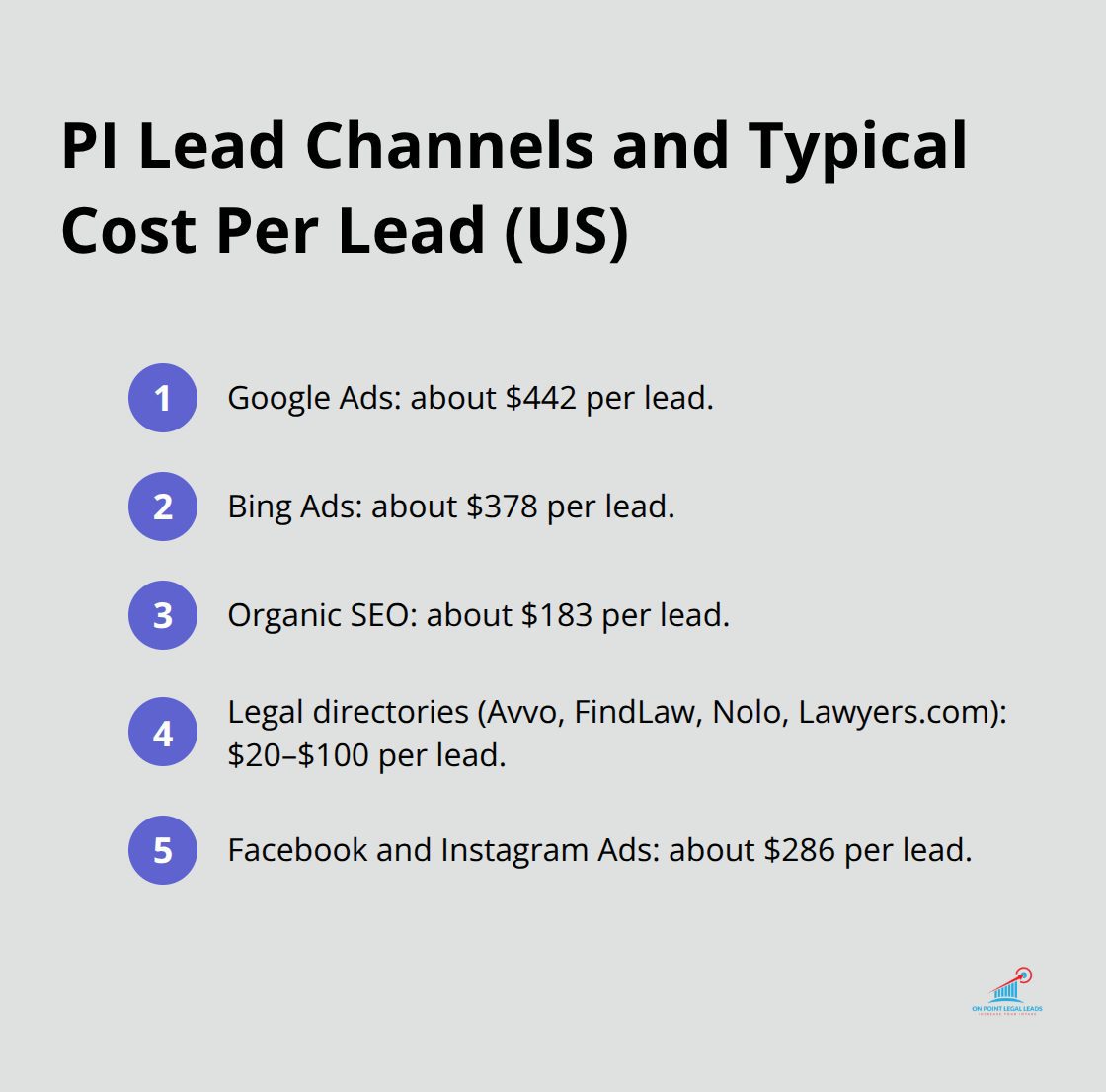
Legal directories like Avvo, FindLaw, Nolo, and Lawyers.com operate as aggregators, collecting leads from multiple sources and reselling them to attorneys; these platforms typically charge between $20 and $100 per lead depending on injury severity and geography. Facebook and Instagram social ads fall in the $286 range per lead.
However, after 10 years in the industry, we’ve discovered that reliable personal injury leads for sale improves when they are exclusive, meaning the PI leads are not shared or resold.
Understanding Lead Source Structure for Reliable Personal Injury Leads for Sale
The critical distinction when considering where to get reliable personal injury leads for sale lies in how providers source their leads.
Some providers generate PI leads for sale directly from their own marketing channels, while others aggregate and resell leads from multiple sources. We generate our reliable personal injury leads for sale in house. And we also have select trusted partners we have vetted through our legal intake center. This matters because aggregated leads often reach multiple attorneys simultaneously, forcing your intake team to compete against other firms for the same prospect. Exclusive leads, where only one attorney receives the prospect, convert at substantially higher rates than shared leads. Real-time delivery amplifies this advantage-leads contacted within minutes convert far better than aged leads sitting in a queue for hours or days.
And don’t forget about the value of well-trained legal intake agents, which area we pride ourselves. A New Jersey dog bite attorney saw a 58% reduction in campaign conversion costs after optimizing their landing page and intake process, demonstrating that lead source quality depends partly on how quickly your team responds.
How Providers Qualify Reliable Personal Injury Leads for Sale
Some legitimate PI lead providers implement multi-point screening before delivery. This includes verifying accident details against police reports or insurance claims, confirming injury severity through medical documentation or treatment records, checking insurance coverage to assess case viability, and confirming the prospect has no existing attorney representation. Yet, the price of these reliable personal injury leads for sale are at the top end because these are typically at the top end of qualifying.
Some lead generators may capture specific intake information like we do at On Point Legal Leads, This includes, but is not limited to, accident date and location, vehicles involved, injuries sustained, medical treatment received, insurance claim status, and whether the prospect has already consulted another attorney. In fact, we have over 100 fields that may be completed to ensure the highest reliability possible with personal injury leads for sale. Weak providers skip these steps entirely, simply collecting contact information and selling it to whoever pays.
Qualified leads with verified injuries and clear liability indicators convert at rates 60-80% higher than unqualified leads. You should ask prospective lead providers exactly what their qualification process includes and request sample lead data showing the information captured.
Red Flags in Lead Provider Relationships
Red flags appear immediately in conversations with unreliable providers. If they claim reliable personal injury leads for sale are non-exclusive but sell to multiple attorneys in your region, they waste your money. In other words, your intake team will call a prospect already represented by a competitor.
If a marketer cannot document their sources for personal injury leads or explain how they verify information, they likely aggregate low-quality data. Providers charging suspiciously low prices, like $15 per lead in a competitive market, either sell shared leads or attract low-intent prospects.
Lack of compliance documentation raises serious concerns-your firm bears legal risk if leads were generated without proper consent or in violation of advertising ethics rules. ABA Rule 7.2 allows lawyers to pay for advertising and lead generation, but fee-splitting with non-lawyers is prohibited. Ask whether their marketing materials clearly identify the firm, whether they maintain written agreements with lead sources, and whether they comply with applicable rules. Providers unwilling to provide performance metrics or case conversion data hide poor results.
The best providers like us at On Point offer real-time delivery systems, transparent pricing structures, and detailed lead qualification criteria.
Evaluating Provider Credibility for Reliable Personal Injury Leads for Sale
Trustworthy providers of reliable personal injury leads for sale allow you to audit lead quality before committing to larger contracts rather than demand upfront annual fees with no trial period. They should articulate their screening methodology clearly and share sample leads demonstrating the information they capture. Providers who operate with transparency about their sources, qualification standards, and compliance practices stand apart from those making vague promises.
When you evaluate a provider, request documentation of their compliance practices, ask for references from other attorneys using their service, and test their lead quality with a small initial purchase. This approach protects your firm from wasting budget on low-quality prospects while building a relationship with a provider who understands your case acceptance criteria and conversion needs.
The next step involves understanding what actually makes a lead worth your time and money-and how to spot the difference between a prospect ready to hire counsel and one who will never become a client.
Comparing Lead Generation Methods for PI Attorneys
Purchased leads and organic generation represent fundamentally different bets on your firm’s capacity and market position. Purchased leads arrive immediately with qualified prospects actively seeking representation, while organic generation through SEO and content marketing builds assets over months but costs less per lead long-term. The choice depends entirely on your firm’s runway, intake capacity, and risk tolerance. Law firm SEO costs anywhere from $2,500 to $10,000+ per month, but you’ll wait 4-6 months before seeing meaningful volume. Google Search Ads cost around $442 per lead but put qualified prospects in your pipeline tomorrow. Local Service Ads fall between these extremes at $378 per lead with faster results than SEO but higher costs than organic. Most successful PI firms run both simultaneously. Your intake team processes purchased leads while your SEO investment compounds in the background, creating a hybrid pipeline that reduces dependence on any single channel.
The Economics of Purchased Leads
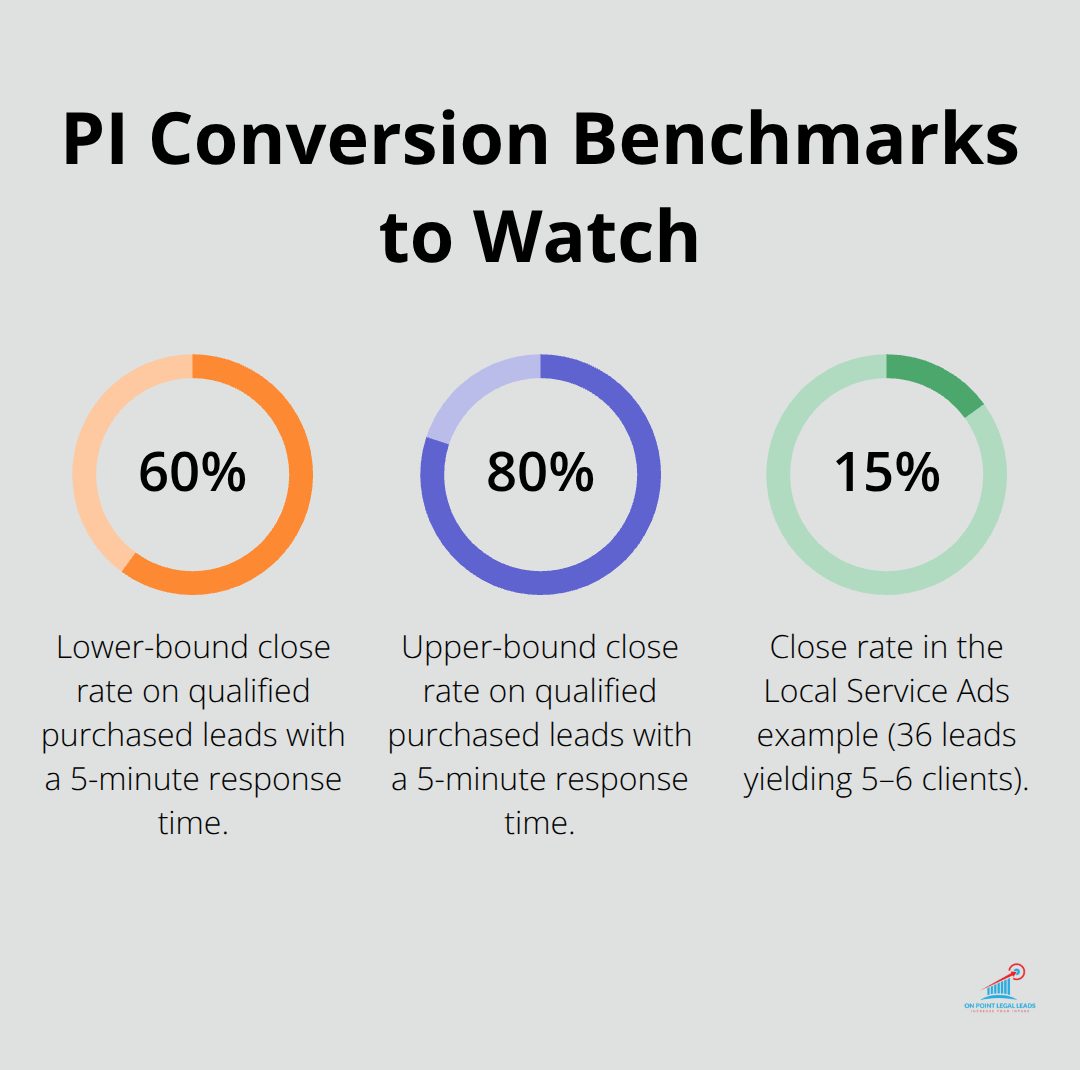
The economics heavily favor purchased leads for firms with available intake capacity. If your team answers calls within five minutes, your close rate on qualified purchased leads runs 60-80% according to industry data. That speed advantage disappears with organic leads where prospects contact you days or weeks after initial intent fades. A firm spending $5,000 monthly on Local Service Ads typically acquires 36 leads with a 15% close rate, yielding 5-6 new clients and a cost per client around $830-$1,000.
Compare this to SEO: $5,000 monthly builds authority over time but produces zero leads in month one and modest volume in month two.
Case Type and Regional Cost Variations
Medical Malpractice and Product Liability leads cost $512 and $476 respectively due to case complexity, while Slip and Fall leads run $312-allowing you to test channels with lower-value cases before scaling budget toward higher-value practice areas. Regional variation matters significantly: Northeast markets cost $468 per lead due to aggressive bidding in cities like New York and Boston, while Midwest markets run $314, making them ideal testing grounds before scaling elsewhere.
Identifying Your Conversion Bottleneck
The real constraint isn’t lead cost; it’s whether your team converts them. If your consultation-to-client conversion rate sits below the 5.45% average for personal injury law, purchased leads waste money regardless of quality. If it exceeds 50%, you’re underutilizing your intake capacity and leaving revenue on the table. Run a 90-day baseline measuring total calls, qualified leads, consultations scheduled, consultations completed, and clients hired. That funnel reveals exactly where your biggest leak exists. Tighten intake response time from 30 minutes to 5 minutes and watch consultation show rates jump. Improve your consultation framework to clearly present pricing and next steps, and watch close rates climb. Only after you’ve optimized those metrics should you increase lead volume through purchased sources.
Building Your Hybrid Pipeline
Exclusive motor vehicle accident leads with pre-qualified prospects deliver real-time conversion advantages and can increase your caseload by 30-50%. When you receive a lead from a provider committed to exclusivity, you’re the only attorney contacting that prospect, eliminating competition from other firms and maximizing your chances of retention. This exclusivity matters most when combined with rapid response-your intake team connects with potential clients while they’re actively seeking representation.
The next critical question isn’t which channel to use, but how to evaluate whether a specific lead actually meets your case acceptance standards before you commit budget at scale.
What Actually Separates High-Quality Leads from Expensive Mistakes
A lead claiming to be high-quality that should rise to the level of reliable personal injury leads for sale means nothing without verification. Your intake team needs concrete data proving injury severity, clear liability, and insurance coverage before investing time in consultation scheduling. The difference between a lead that converts to a signed case and one that wastes your team’s time comes down to what information the provider captured during qualification and how thoroughly they verified it.
Personal Injury Leads for Sale: Verification Standards That Matter
Most providers capture basic contact details and accident description, then call it qualified. That approach fails catastrophically. You need documented proof that the prospect has genuine injuries requiring treatment, clear fault indicators supporting liability, active insurance coverage to fund the case, and no existing attorney representation. Without these specifics, your team spends hours on consultations that never convert to retainers. Every prospect should undergo multi-point screening including accident detail verification against police reports or insurance claims, injury confirmation through medical treatment records or provider documentation, insurance coverage assessment, and representation status checks. This filtering eliminates time-wasters before they reach your calendar. When your intake team receives a lead, they know the prospect has documented injuries, clear liability indicators, and the financial capacity to support a case through resolution.
Insurance Coverage and Case Viability
Insurance coverage and case viability in personal injury law determines case viability more than any other factor. A prospect with severe injuries but no insurance coverage and minimal assets becomes a collection problem masquerading as a case opportunity. Legitimate providers verify coverage status and policy limits before delivery, ensuring your team pursues cases with realistic settlement or judgment potential. This verification step separates providers who understand PI law from those simply selling contact lists.
Intent and Response Speed
Prospect intent separates serious inquiries from casual information seekers. Real-time delivery matters enormously here; leads contacted within one minute convert at 3X the rate of those who wait even five minutes. Exclusive leads amplify this advantage further. When your team calls a prospect and they haven’t already heard the same pitch from three competing firms, your retention rate climbs substantially. Shared leads create a race to the bottom where the fastest dialer wins, not the best attorney.
Your firm’s intake process must match lead quality with speed. If you’re acquiring exclusive real-time leads but responding within 30 minutes instead of one minute, you’re wasting the provider’s qualification work and your lead budget. Conversely, if your team responds within minutes but receives aged shared leads, you’re throwing resources at prospects already committed elsewhere. The combination of exclusive delivery and rapid response creates the conditions for maximum conversion.
Final Thoughts on Reliable Personal Injury Lead for Sale
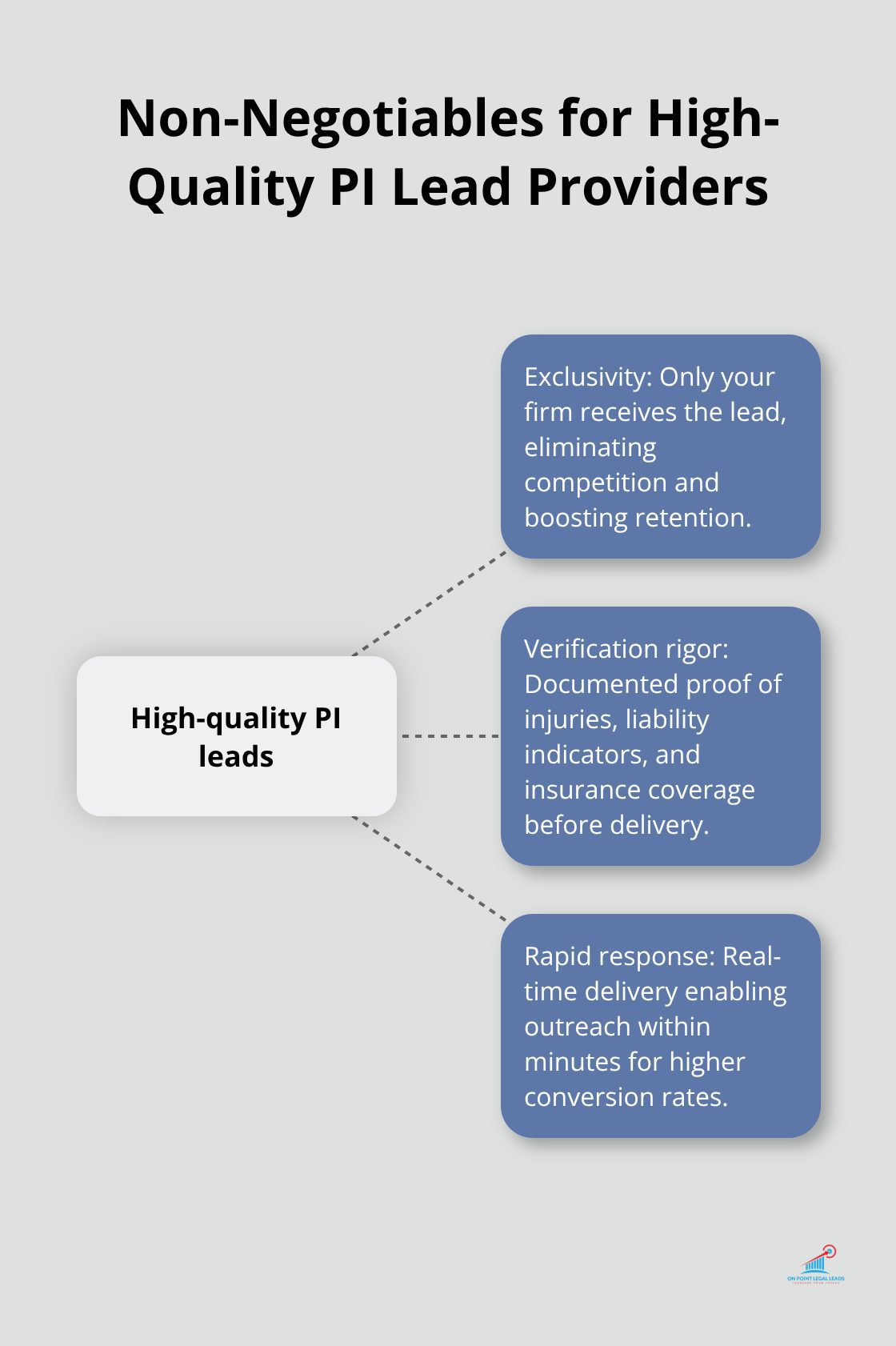
Selecting a provider that generates reliable personal injury leads for sale requires three non-negotiable standards: exclusivity, verification rigor, and rapid response capability.
Exclusive leads eliminate competition from other firms contacting the same prospect, verified information confirms injury severity and liability indicators before your team invests time, and rapid response means your intake team connects with prospects within minutes rather than hours. Providers meeting all three standards deliver cases; those falling short on any dimension waste your budget.
Test any provider with a small initial purchase before committing to a large contract. Request sample leads showing the specific information they capture during qualification, ask how they verify accident details and insurance coverage, demand documentation of compliance practices, and request references from other attorneys using their service. This vetting process protects your firm from providers making promises they cannot keep and ensures you work with sources that understand personal injury law and case acceptance criteria.
We at On Point Legal Leads deliver pre-qualified motor vehicle accident leads with verified injuries, clear liability, and active insurance coverage. Every lead undergoes multi-point screening before reaching your intake team, and we maintain strict TCPA and legal advertising compliance to protect your firm while maximizing conversion potential. Your firm’s growth depends on acquiring cases, not just leads, and that distinction separates providers committed to your success from those simply selling contact information.